Engineers often ask whether thermoforming or injection molding is the right fit for a part. The answer depends on part size, expected volume, and budget. The two processes share a goal but differ sharply in how they get there.
How each process works
Thermoforming heats a flat plastic sheet until it is pliable, then draws it over a mold using vacuum or pressure. Injection molding forces molten plastic into a hardened steel or aluminum mold at high pressure, where it cools into the finished shape.
Where thermoforming wins
- Large parts. Hill Plastics forms sheets up to 5x9 feet.
- Lower tooling cost, using wood, polyurethane, or aluminum molds.
- Faster path from prototype to first parts.
- Economical for low and mid volume production runs.
Where injection molding wins
- Very high part volumes.
- Tight dimensional tolerances on small, complex geometry.
- Parts with thick, uniform walls and fine molded detail.
A practical rule of thumb
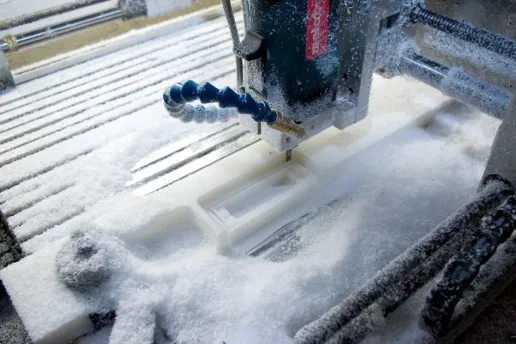
If your part is large, your volume ranges from prototype to mid-thousands, and you want to keep tooling cost in check, thermoforming is usually the better fit. Hill Plastics thermoforms and vacuum forms parts for aerospace, telecom, medical, and industrial OEMs from a single facility in Lewisville, TX, with tooling, forming, fabrication, and CNC trimming under one roof.
Share your drawings and our engineering team can recommend the process that fits your part, your volume, and your timeline.
Ready to start?
Talk through your part with our engineering team
Share your drawings and we will recommend the process, material, and tooling approach that fits your project.